The Stratospheric Ballooning Association is proud to announce…
Great Stratospheric Ballooning Challenge
Challenge Information
Open to all
The challenge is geared toward students at any public or private educational institution. Higher education is the target audience, but we encourage groups to work with K-12 and other educational institutions.
STEM Challenges
Join us for an exhilarating adventure with the Great Stratospheric Ballooning Challenge! This unique event combines the thrill of high-altitude ballooning with exciting STEM challenges. Test your skills in designing, building, and launching a high-altitude balloon while showcasing your science, technology, engineering, and math knowledge. Compete with teams worldwide and push the boundaries of innovation in the stratosphere. Are you ready to elevate your STEM education to new heights? Sign up now and be part of this extraordinary experience!
Collaboration
At the Great Stratospheric Ballooning Challenge, we believe that collaboration is key to success. We encourage teams to work together not only with each other but also with participants from K-12 schools and other educational institutions. By fostering collaboration, we aim to promote knowledge-sharing, teamwork, and a sense of community among all participants. Join us and experience the power of collaboration in reaching new heights!
Challenge Information
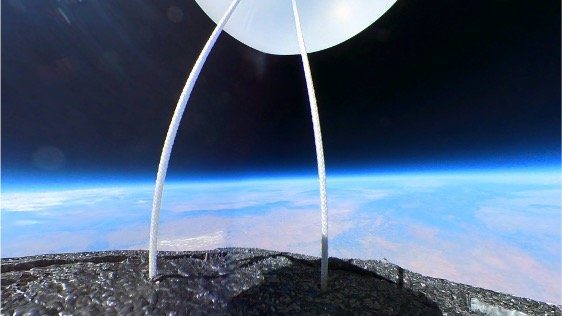
The Stratospheric Ballooning Association invites proposals from accredited two- and four-year colleges and universities located in the United States or any U.S. territory to compete in the Great Stratospheric Ballooning Challenge (GSBC). This is a student design challenge that asks teams to design, build, and fly a Near Space Vehicle (NSV), or “Lunar Module,” carried into the stratosphere (minimum altitude of 18.3 km) by a high-altitude balloon. For its inaugural year, the challenge is lunar-themed and is codenamed Operation: Lunar Field. The challenge is designed to give undergraduate and graduate students hands-on experience with mission planning, systems engineering, flight prediction, and autonomous instrumentation, skills directly applicable to NASA’s Artemis-era lunar and planetary surface missions.
Teams plan an independent flight, pre-declare a target landing zone, and are scored on how closely their Lunar Module lands to that declared point while remaining upright and intact. This challenge is about how accurately a team can predict the balloon’s path, burst altitude, and landing location. In addition, points will be awarded for their ability to autonomously obtain a soil reading after landing. The challenge is intentionally open-ended in its engineering approach and is scored so that it remains accessible to teams across a wide range of budgets: teams may choose any balloon platform, module structure, and instrumentation package that satisfies the rules, requirements, and applicable federal regulations below. The scoring formulas (see Scoring Rubric) are built so that a modestly funded team can outscore a heavily funded one on technical merit alone.
Eligibility
E.1. The competition is open to any accredited institution of higher education located in the United States or a U.S. territory.
E.2. Pre-College teams are also welcome but must coordinate with a participating college or university team.
E.3. Each team shall consist of a minimum of five (5) students currently enrolled at the institution they represent.
E.4. Each team shall have at least one (1) faculty advisor affiliated with the institution.
E.5. An institution may field more than one team; each team shall register, submit, and be scored independently.
Program Timeline
Dates are subject to change; the current schedule of record is below.
September 10th, 2026 - Registration opens / Rules posted
October 2, 2026 - Competition Proposal submission due
October 16, 2026 - Notification of acceptance into the challenge
November 20, 2026 - Spacecraft Engineering & Preliminary Flight Plan (SEPFP) submission due
May 15, 2027 - Last day to submit a Flight Plan / 24 hours left to fly
May 20, 2027 - Final Reports due
May 25th, 2027 - Awards announced
June 9–11, 2027 - Winners attend AHAC 2027
Mission Overview
Your mission is to design, build, and fly a Lunar Module carried aloft by a high-altitude balloon. Teams plan the flight and select a landing zone in advance of launch, then are scored on landing accuracy, burst-altitude prediction, survivability, and science return.
Flight and Operations Objective
Land the Lunar Module as close as possible to the team’s declared, pre-launch predicted landing point, while keeping the spacecraft upright and intact. The spacecraft must be upright immediately after landing or it may attempt to self-right itself after touchdown.
Engineering Objective
Autonomously detect the moment the balloon bursts and raise a flag (or equivalent visible marker) on the Lunar Module as close as possible, by altitude and time, to that actual burst event.
Science Objective
Carry plant seeds of the teams choosing. Teams must monitor the environmental conditions inside and outside the capsule they are using to carry the seeds. Teams are also encouraged to grow their seeds and monitor the results. recovery.
Challenge Objectives Summary
Predict and declare a target landing location immediately before launch.
Design and build a Lunar Module payload that can survive the flight and land safely.
Detect the balloon's burst in real time and “raise a flag” as close as possible to the actual burst altitude and time.
Land the module upright and intact as close as possible to the declared landing point.
Include a seed capsule payload and monitor the environmental conditions inside and outside the capsule..
Document the flight with GPS data, plus video and/or still photographs.
Teams may make multiple flight attempts before the challenge end date. Only the single best-scoring, fully-documented flight will count toward final standings (see Scoring Rubric).