SBA Officers

Matthew E. Nelson
President
Professor Matthew Nelson is the president and one of the SBA's founding members. As president, Professor Nelson oversees the organization's day-to-day operations and is the board of directors chairman. As president, he also helps define the vision and goals of the organization.
Prof. Nelson has over 18 years of experience in high-altitude ballooning and leads the High Altitude Balloon Experiments in Technology (HABET) team at Iowa State University. He holds degrees in Electrical Engineering (BS) and Computer Engineering (MS) and is completing his Ph.D. in Human-Computer Interactions in Fall 2024. Prof. Nelson is an Associate Teaching Professor at Iowa State University and serves as the director of the Make to Innovate program. This hands-on learning program includes Iowa State University’s high-altitude balloon, CubeSat, rocket, and unmanned aerial vehicle projects. He also serves as the Assistant Director for the Iowa Space Grant Consortium.
Prof. Nelson holds an FAA Private Pilot License, a Part 107 license, and an Amateur Radio license.

Ron Fevig
Vice-President of Research
Tyler McWilliam
Vice-President of Private and Government Relations
Dr. Ronald Fevig serves as the Vice-President of Research and is one of the founding members of the SBA. Dr. Fevig works with the SBA president on research projects and oversees the Special Projects committee. This committee works on grant proposals and additional special projects for the SBA.
He possesses both a Bachelor's degree from North Dakota State University and Master's degree from the University of North Dakota in Mathematics. He also earned a Master's degree in Space Studies from the University of North Dakota. Dr. Fevig is an associate professor at the University of North Dakota in the Space Studies Department. Dr. Fevig's teaching focuses on orbital mechanics and space mission design. He has been engaged in mostly student-oriented research projects involving spacecraft engineering, planetary sciences, and high-altitude ballooning.
Dr. Fevig is a USPA-licensed skydiver and an FCC-licensed amateur radio operator.
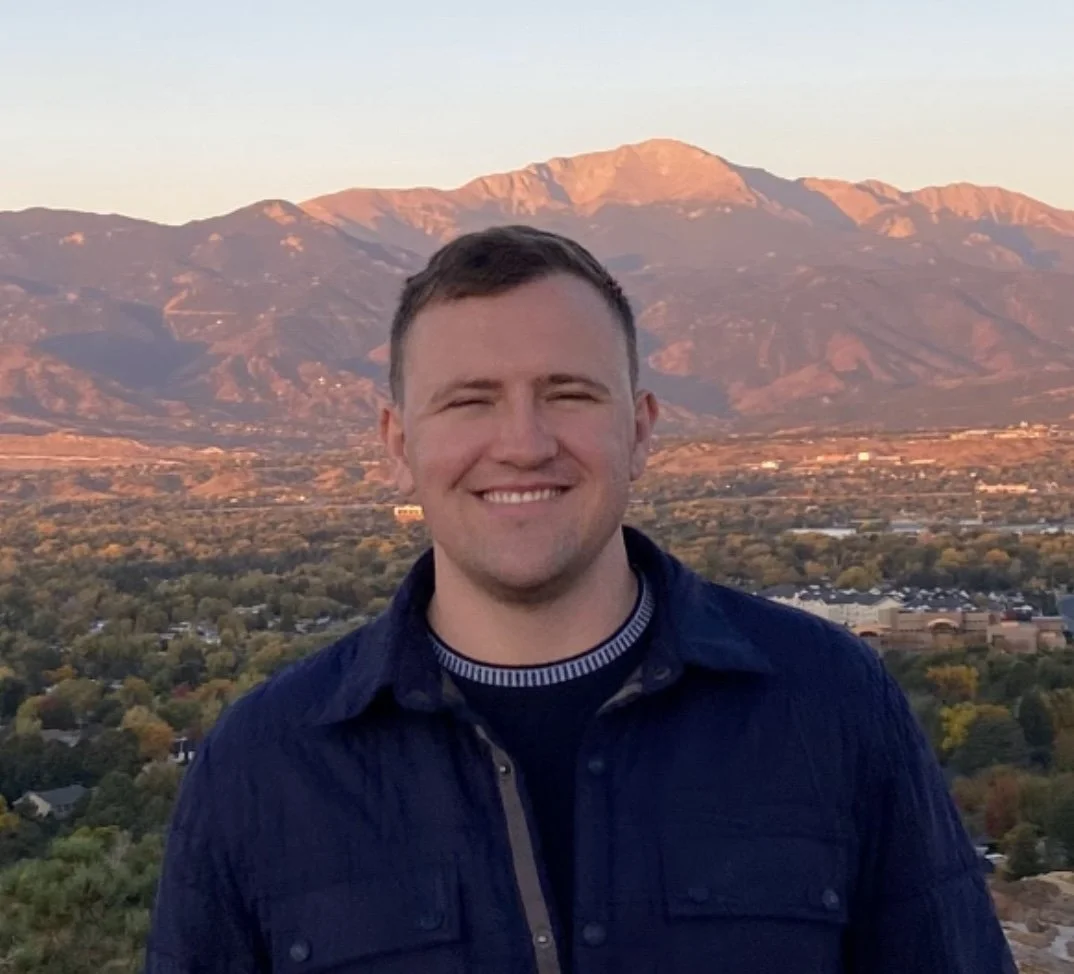
Mr. Tyler McWilliam serves as the Vice-President for Private and Government Relations. As the VP for Private and Government Relations, Mr. McWilliam works on relations within the private sector and government, and on how the SBA can work within those sectors to promote high-altitude ballooning.
He attained a Bachelor of Science in Environmental Science from the University of Central Arkansas and a Master of Science in Geological Engineering from the Missouri University of Science and Technology. Additionally, he has graduated from multiple US Military courses, including the Space Operations Officer Qualification Course, Space Control Fundamentals, the Engineer Captain's Career Course, and a High Altitude Basics Course he co-developed. Tyler's background as a US Army veteran includes nine years of experience split between five years as an Engineer Officer and four years as a Space Operations Officer. His Space Operations experience included one year as a Signal Company Commander and three years focusing on Multi-Domain and High Altitude operations.
Tyler is a Program Manager specializing in Stratospheric Mission Solutions at Urban Sky. Urban Sky's products enable routine and easy access to the stratosphere and the value locked within it. Tyler's future aims are to help build the next age of balloon flight and expand access to the stratosphere alongside government, academic, and industry partners.
Tyler is also a PADI-certified open water scuba diver and has held memberships with the Army Engineer Association (AEA), Signal Corps Regimental Association (SCRA), the Association of United States Army (AUSA), the Air & Space Forces Association (AFA), and the Army Space Professionals Association (ASPA).
Professor Erick Agrimson serves as the Chief Editor for the SBA and is also a founding member of the SBA. As the Publications Director, Professor Agrimson oversees the Publications Committee, which handles all conference papers and the Journal for High Altitude Ballooning (JHAB).
Professor Agrimson is an Associate Professor in the Physics department at St. Catherine University. He is currently serving as affiliate director for St. Catherine University’s portion of the Minnesota Space Grant Consortium, a NASA outreach program. Professor Agrimson uses high-altitude weather balloons to deliver payload boxes with varied instrumentation to study near space. St. Kate’s has had balloons reach altitudes of up to 35,000 meters (~115,000 feet), depending on the balloon's size and payload mass. One of the current projects involving collaborative undergraduate researchers is the investigation of the Regener-Pfotzer (R-P) maxima in galactic cosmic ray showers. Agrimson holds a BS (with a concentration in space physics) from Augsburg College, an MS from the University of Iowa, and has completed advanced coursework toward a PhD in plasma physics.
SBA Advisory Committee
The SBA Advisory Committee comprises representatives from academia, the private sector, and government agencies. These representatives provide guidance and recommendations to the SBA
Dr. James Flaten serves as an academic representative for the SBA and is also a founding member of the SBA. Dr. Flaten has served the SBA in several past roles, including planning the Academic High Altitude Conference, serving as an editor for the conference papers, and reviewing for the Journal of High-Altitude Ballooning.
Dr. Flaten is an Associate Contract Professor in the Aerospace Engineering and Mechanics Department at the University of Minnesota - Twin Cities. Dr. Flaten holds a Ph.D. in Physics from the University of Minnesota - Twin Cities and a B.A. in Physics and Mathematics (with Computer Science emphasis) from Carleton College. Dr. Flaten serves as the Associate Director of the Minnesota Space Grant Consortium (MnSGC), a NASA higher education program that promotes NASA-related activities statewide. He teaches NASA-related classes, including freshman seminars on high-altitude ballooning and high-power rocketry. Also, he works with college students and faculty (and others) on out-of-class NASA-related projects, including building and flying miniature spacecraft into the stratosphere using weather balloons, developing science payloads for NASA suborbital rocket flights, and mentoring student teams participating in high-power rocketry competitions.
Mr. Bill Brown serves as an amateur radio representative for the SBA. Bill Brown, amateur radio callsign WB8ELK, launched his first balloon into the stratosphere on August 15, 1987, which just happened to be his birthday. It was the first privately funded high altitude balloon to carry a UHF television transmitter aloft. The image was seen over 300 miles in all directions. Less than a year later, he launched the first TV camera to transmit live video of the incredible view from the edge of Space. Since that time, Bill has launched over 700 balloons ranging in size from 10-gram Pico balloons to 400-pound Rockoons. Bill’s goal has always been to use high-altitude balloons to encourage students to pursue careers in STEM. He has mentored many student balloon projects over the decades, from elementary to college level.
Bill states that if you can launch a balloon that students can track in real-time on their Smartphones then you have them hooked and is a great way to teach students about Space and science. He likes to say it is “Taking Amateur Radio and STEM to New Heights”. In 1997, he was part of a team called HALO (High Altitude Lift Off) that launched a large hybrid rocket from a balloon in the stratosphere. It was listed at the time in the Guinness Book of Records as the highest amateur-built rocket launch. In addition to the larger balloon missions he still flies and supports, Bill has designed a Pico balloon tracker called the Skytracker that weighs less than half an ounce. It was designed to be totally solar-powered and lightweight enough to fly underneath a small Mylar-style party balloon. This lightweight superpressure balloon can stay aloft in the upper Jet Stream for days, weeks, and sometimes for over a year, and often circumnavigates the World multiple times. It transmits its position via amateur radio digital modes, which are received by a Worldwide network of ground stations. Bill recently retired from the NASA SLS Artemis Moon program, where he was a Sr. Engineer at the Marshall Space Flight Center. Bill is a recent addition to the SBA board and will be reaching out to many of you in his new role at this conference.
Reference:https://www.arrl.org/files/file/QST/This%20Month%20in%20QST/May2017/GLIFORT.pdf
Dr. Kendra Sibbersen serves as an academic representative for the SBA. Dr. Kendra Sibbernsen has taught physics and astronomy at the college level for over 25 years. She currently works at Metropolitan Community College in Omaha, NE. Kendra has developed many undergraduate research opportunities for her students over the years, including projects using cosmic ray detectors, high-altitude balloon projects, and citizen science projects for SETI (Search for Extraterrestrial Intelligence) and Unistellar using electronic telescopes. Kendra and her husband, Michael, led the team from Nebraska that participated in the NASA Nationwide Eclipse Ballooning Project in 2017, as well as the annular solar eclipse in 2023 and the total solar eclipse in 2024. Kendra and Michael are heavily involved in the development of Branched Oak Observatory, a non-profit sky park north of Lincoln, Nebraska, focusing on astronomy education and outreach.

Erick Agrimson
Chief Editor

James Flaten
Academic Representative

Bill Brown
Amateur Radio Representative
